Call Us: 804-518-8332
Call Us: 804-518-8332

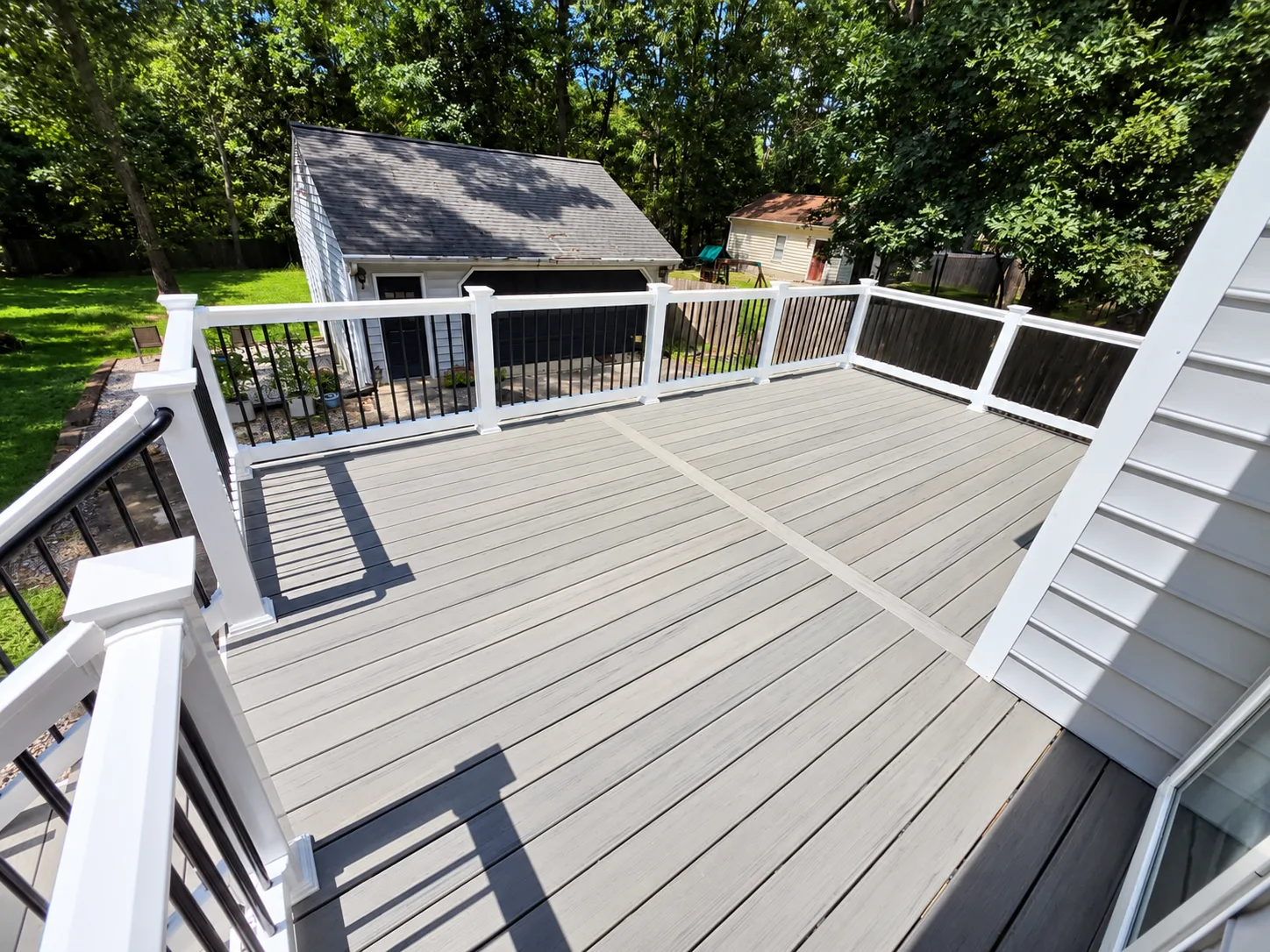
Yes, composite deck boards can become noticeably hot in direct summer sun, especially darker colors, but how hot they feel depends on the specific product, color, sun exposure, and surrounding conditions.
Wood and other decking surfaces can also become hot, so the more useful question is how different materials and colors compare under similar Virginia Beach conditions.
A simple way to think about deck heat is:
direct sunlight + darker board color + material/product characteristics = higher surface temperature
For homeowners comparing materials, deck orientation, shade, color, and the specific composite product all matter.
Composite decking can become uncomfortable in strong direct sunlight, but not every board performs the same way.
The amount of heat a deck surface absorbs depends on factors such as:
A full-sun deck used in the afternoon will have different comfort considerations than a partially shaded deck used mostly in the evening.
Composite decking gets hot because the board surface absorbs solar energy and converts part of that energy into heat.
The amount of heat retained at the surface varies by board color, material composition, surface characteristics, and how long the boards remain in direct sunlight.
Outdoor air temperature and deck surface temperature are not the same thing.
A deck board sitting in direct sunlight can feel much hotter than the surrounding air because the surface continues absorbing solar energy.
That is why a comfortable air temperature does not automatically mean the deck will feel comfortable under bare feet.
Sometimes, but not in every situation. Composite and wood decking can both become hot, and the result depends on the specific material, color, surface finish, and exposure.
It is too broad to say that all composite decking becomes hotter than all wood decking.
| Comparison Factor | Composite Decking | Wood Decking |
| Heat in direct sun | Can become noticeably hot, especially darker boards | Can also become hot during prolonged exposure |
| Color influence | Darker colors generally absorb more solar energy | Dark stains and darker wood tones can also feel warmer |
| Barefoot comfort | Varies by product, color, and exposure | Varies by species, finish, color, and exposure |
| Product variation | Different formulas and caps can perform differently | Different species and finishes can behave differently |
| Appearance | Wide range of colors and wood-look finishes | Natural wood appearance with stain options |
| Sunny-deck suitability | Can work well when heat is considered during selection | Can also work, but surface heat still matters |
| Shade influence | Partial shade can significantly change surface comfort | Shade can also reduce surface heating |
Heat should be one factor in the material decision rather than the only factor.
In many cases, darker composite boards absorb more solar energy and may feel hotter than lighter-colored boards under similar exposure.
That does not mean every light-colored board will stay cool or every dark board will become uncomfortable.
Darker surfaces generally absorb more solar energy, while lighter surfaces reflect more of it.
For a sunny Virginia Beach deck, color should be considered alongside:
If barefoot comfort is a priority, lighter colors may deserve stronger consideration.
When possible, compare sample boards in direct sunlight at the property or under similar exposure before choosing a final color.
Yes. Some composite deck surfaces can become uncomfortable for bare feet after prolonged direct sun exposure.
How noticeable that becomes depends on the board, color, exposure, and how the deck is used.
Barefoot comfort matters more when the deck serves:
Homeowners in those situations should give surface heat more weight during material selection.
Yes. Deck orientation affects how much direct sunlight reaches the boards and how long the surface remains exposed.
A deck that receives strong afternoon sun may experience more surface heating during the hours when homeowners are most likely to use it.
A full-sun deck receives little protection from the house, trees, or nearby structures.
In that situation, board color and product characteristics become more important because the decking remains exposed for longer periods.
A partially shaded deck may receive direct sunlight only during certain hours.
Shade from the house, roofline, mature trees, or nearby structures can significantly change how the surface feels throughout the day.
It can, especially if the deck is used most often later in the day.
Afternoon sun may combine with already-warm air and accumulated surface heat, making a west-exposed deck feel less comfortable during peak use.
The better question is not only how much sun the deck receives, but when that exposure occurs.
Yes, some composite products are designed with materials, cap technologies, or lighter colors intended to reduce heat absorption compared with other boards.
Performance still varies by manufacturer and product line, so composite decking should not be treated as one thermally identical category.
A board marketed for cooler surface performance may still become uncomfortable in direct summer sun.
Useful questions include:
Product-specific information is more useful than broad assumptions about composite decking as a category.
Deck design can reduce direct exposure by placing the most-used areas where shade is naturally available or by coordinating the deck with covered outdoor features where appropriate.
The goal does not have to be shading every square foot of the deck.
Useful design considerations may include:
Shade planning is most useful when it happens while the deck layout is being developed.
Yes. Waterfront decks may receive broader sun exposure because there are often fewer trees or nearby structures providing shade.
The exact conditions vary by property, but open views can also mean more direct solar exposure.
Waterfront deck planning may need to balance:
A lighter composite color may be useful on one exposed property, while another may have enough structural or natural shade to allow more flexibility.
Humidity affects how hot and uncomfortable the outdoor environment feels, but it is not the same as direct solar heating of the deck surface.
Sun exposure, board color, and material characteristics remain the main factors affecting surface temperature.
Virginia Beach humidity may still influence how comfortable the overall deck feels even when the surface itself is not unusually hot.
Yes. On a deck with strong direct sun, heat should be part of the color-selection process.
If barefoot comfort matters, a very dark color may deserve more scrutiny than a lighter alternative.
The decision should still balance:
Lighter colors can reduce one heat-related factor, but they do not guarantee a cool deck.
It can be. Composite decking can work well on a full-sun deck when the homeowner understands the heat trade-offs and selects the product, color, and layout accordingly.
For a sunny Virginia Beach deck, homeowners should compare:
Composite does not need to be eliminated simply because the deck receives strong sun.
Neither material is automatically better for every sunny backyard.
Composite may make sense when homeowners prefer its appearance, color consistency, and fit with the overall design, while wood may deserve consideration when natural material appearance is a higher priority.
Composite may be a strong option when:
Heat should still be discussed before final board selection.
Another option may deserve consideration when surface comfort is one of the highest priorities and the deck will receive prolonged direct sun with very little shade.
That does not automatically mean wood will stay cooler.
The better approach is to compare actual materials and colors under realistic conditions whenever possible.
A pool can make surface comfort more important because people are more likely to walk barefoot between the water and seating areas.
That makes board color, sun exposure, walking paths, and shaded areas especially relevant.
A dark board that works well on a covered deck may feel very different beside an exposed pool.
Heat matters, but it should not be the only factor in a decking decision.
Homeowners may also compare:
The best material choice is the one that balances comfort with the rest of the project's structural and design priorities.
Start by evaluating sun exposure, deck orientation, board color, specific product characteristics, and how the deck will actually be used.
For a full-sun Virginia Beach deck, lighter colors and shade planning may deserve more attention. For a partially shaded deck, homeowners may have more flexibility in balancing appearance and surface comfort.
If barefoot use is important, compare the actual board options rather than assuming all composite decking performs the same way.
Homeowners planning a composite deck in Virginia Beach can contact Chesterfield Fencing & More to compare board colors, sun exposure, shade options, layout, and barefoot-use concerns before choosing a material.